
The landscape of fundraising for charities is experiencing an unprecedented structural shift in 2026. While the proportion of Canadians claiming charitable tax deductions has fallen to historic lows, the total dollar volume of giving has climbed to $12.8 billion. This wealth is heavily concentrated among high-net-worth individuals (HNWIs) and older demographics, requiring Canadian non-profits to completely rethink their major gift pipelines.
Simultaneously, Canada is in the midst of an estimated $1 trillion intergenerational wealth transfer, moving significant assets into private family foundations and donor-advised funds (DAFs). To capitalize on this, philanthropic organizations must move away from generic mass solicitations and adopt highly tailored, legally compliant identification and cultivation strategies.
What is High-Net-Worth Donor Cultivation in Canada?

High-net-worth donor cultivation in Canada is the strategic, ethically compliant process of identifying, researching, and stewarding individuals with significant financial capacity to make major philanthropic contributions. Unlike mass-market fundraising, this approach requires triangulating public-domain intelligence—such as Canada Revenue Agency (CRA) filings and corporate disclosures—and engaging in high-touch, value-aligned relationship building that respects Canada’s stringent privacy laws.
Why is the Canadian Philanthropic Landscape Shifting?
Understanding current macro trends is critical for modern advancement teams. Canadian charitable giving is increasingly defined by a shrinking donor base that gives substantially larger amounts.
According to recent Statistics Canada (2025) data, tax filers aged 65 and older now represent 35% of all Canadian donors and contribute 50% of all charitable dollars donated. Meanwhile, the overall donor participation rate has dropped to 16.8%.
The Concentration of Giving
Data published in an Imagine Canada Research Bulletin reveals that 71% of the total value of personal donations in Canada comes from the roughly 9% of donors who give $5,000 or more annually. This “tipping balance” means philanthropic organizations must focus heavily on the top percentile of wealth holders to sustain operations.
The Intergenerational Wealth Transfer
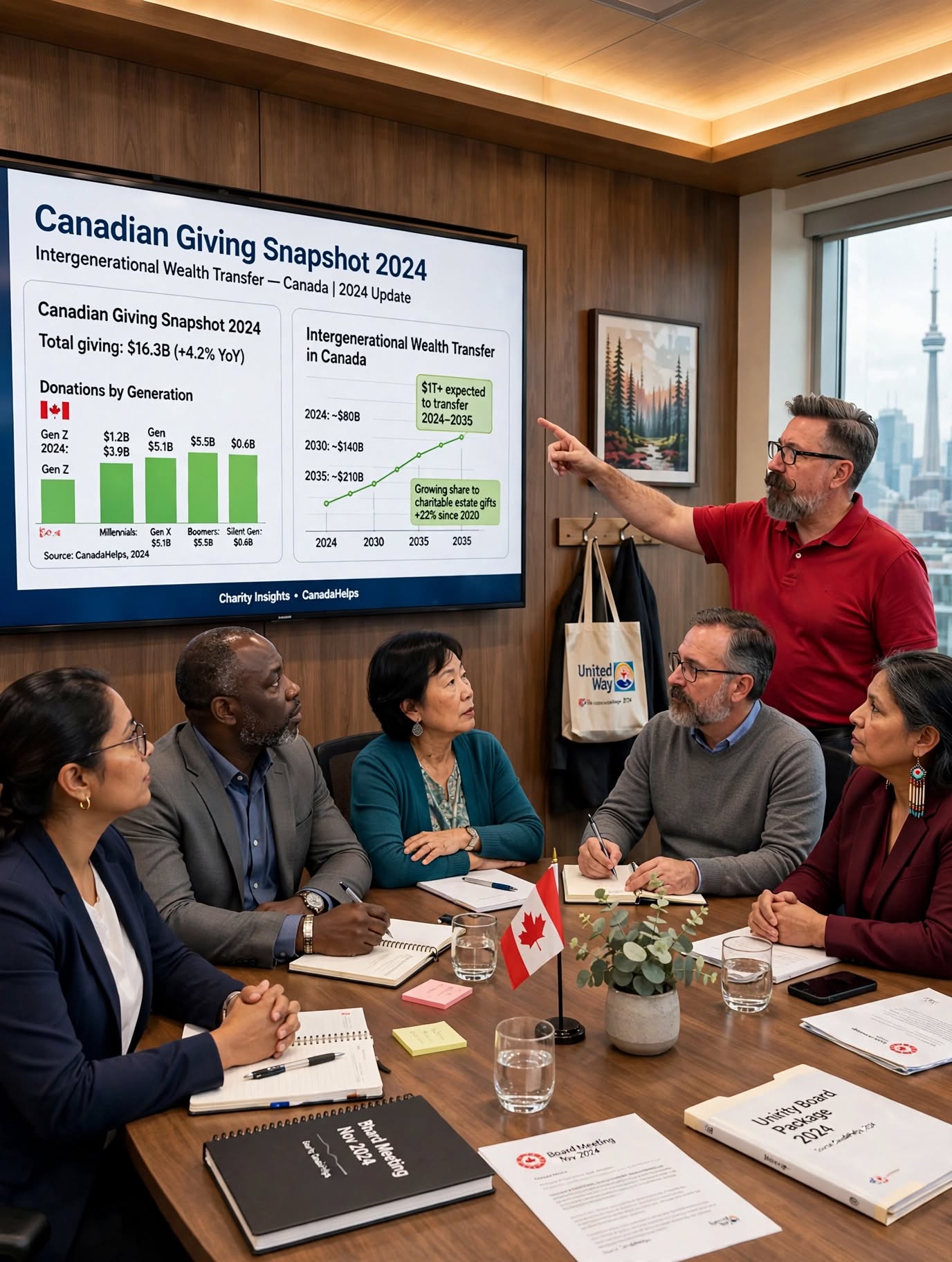
As noted in a Canadian Family Offices and PearTree Canada report, Canada is currently witnessing the transfer of over $1 trillion from Baby Boomers to subsequent generations. This shift is resulting in a rise in structured giving vehicles, as next-generation wealth holders demand transparency, measurable social return on investment (SROI), and direct involvement in the causes they support.
|
Canadian Giving Snapshot (Recent Data) |
Key Metric |
|---|---|
|
Total Claimed Giving |
$12.8 Billion |
|
Donor Participation Rate |
16.8% (Historic Low) |
|
Top ~9% Donors ($5,000+) |
71% of Total Value |
|
Donors Aged 55+ |
69.7% of Total Value |
|
Intergenerational Wealth Transfer |
~$1.0+ Trillion |
How Does Prospect Research Differ for Philanthropic Organizations in Canada?
A critical mistake many Canadian non-profits make is purchasing automated prospect screening software developed in the United States. In the US, county property assessments, real estate purchase prices, and massive political donations are highly public and easily aggregated into “wealth scores.”
In Canada, this automated approach faces severe legal and structural barriers:
-
Strict Privacy Legislation: Canada operates under robust privacy frameworks, including the federal Personal Information Protection and Electronic Documents Act (PIPEDA) and strict provincial acts like Quebec’s Law 25. Ethical prospect research requires appropriate consent and ethical data collection, preventing the mass harvesting of unverified private data, as outlined in the APRA Canada Privacy Guide.
-
Structural Data Scarcity: Canadian real estate registries are maintained provincially and restrict bulk digital harvesting. Furthermore, strict political donation limits (under $2,000 federally) eliminate the massive political-giving indexes commonly used in US databases.
“Given our robust privacy laws, screening in Canada is more difficult and complex but not impossible,” explains Jeff Sodowsky, Vice-President Pacific Region and Senior Consultant at Global Philanthropic Canada. “Some of the indicators may be less obvious. The fruit may not be as apparent as that which can be revealed for searches within the US, it is sweet nonetheless.”
Sodowsky notes that applying US models in Canada fails to capture essential nuance: “When I was immigrating to Canada, I received a very sound piece of advice from another expat that had been residing in Toronto for over a decade. She noted that while we look like one another and often talk like one another, our differences present in very subtle ways that are quite profound for indicating the significant differences in our behaviours that can only really be observed with deeper analyses. It is most definitely true. This offhanded remark was some of the best guidance that I received for how to understand my adopted home, and I see how it plays out day after day in my professional life as well.”
Step-by-Step Guide to Identifying High-Net-Worth Donors in Canada
To build a reliable major gift pipeline, organizations must employ a nuanced, legally compliant methodology.
Step 1: Analyze CRA T3010 Data

The Canada Revenue Agency’s Charities Listings are the gold standard for philanthropic intelligence. By extracting data from Form T3010 returns, researchers can analyze the over 6,000 private family foundations operating in Canada. Reviewing Schedule 6 (Detailed Financial Information) reveals total endowment capital and non-charitable investment portfolios. Furthermore, tracking the Qualified Donees Worksheet (Form T1236) exposes a foundation’s historical giving patterns and grant amounts.
Step 2: Track Disbursement Quotas
Recent federal reforms have established a 5% disbursement quota (DQ) on investment assets exceeding $1 million. As highlighted in a policy position by Philanthropic Foundations Canada, this rule compels larger family foundations to accelerate their granting velocity, making active tracking of foundation assets essential for timely solicitations.
Step 3: Leverage SEDAR+ for Corporate Intelligence
For individual wealth capacity, SEDAR+ (System for Electronic Document Analysis and Retrieval) provides regulatory disclosures for Canadian public companies. This allows researchers to evaluate executive compensation, share ownership, and insider transactions, offering verifiable proof of wealth capacity without violating privacy laws.
Step 4: Map Board Interlocks
Identifying overlaps between corporate boards, non-profit volunteer leadership, and hospital or university foundation cabinets remains one of the most accurate indicators of philanthropic capacity and peer access in Canada.
Step 5: Apply the APRA Ethical Framework
Always adhere to the APRA Canada Statement of Ethics. Verify capacity through multiple public data points, maintain total discretion within authorized fundraising pipelines, and avoid arbitrary wealth algorithm scoring.
What Are the Best Tax-Effective Giving Vehicles for Canadian HNWIs?
Cultivating Canadian HNWIs requires moving beyond generic proposals and discussing tax-efficient philanthropic partnerships. Engaging donors and their wealth advisors early about these vehicles is crucial:
-
Publicly Traded Securities: Donating appreciated publicly listed shares or mutual funds directly to a registered charity eliminates 100% of the capital gains tax while generating a full fair market value donation receipt.
-
Flow-Through Shares: Often utilized by ultra-high-net-worth (UHNW) donors, these shares provide philanthropic liquidity to fund charitable causes at significantly reduced after-tax costs through structured exploration tax credits.
-
Donor-Advised Funds (DAFs): According to Boreal Family Office, DAFs provide immediate tax relief while allowing families to advise on grant distributions over time, making them ideal for multi-generational legacy planning.
Partnering with Expert Philanthropic Counsel
Navigating stringent privacy regulations, complex CRA data, and culturally nuanced cultivation requires localized expertise. Generic software algorithms simply cannot replace on-the-ground intelligence in the Canadian market.

“Having a skilled fundraiser (senior consultant) assist with walking through any screening data can be critical. Interpretation is key,” Sodowsky explains. “In some markets, real estate holdings can have a prospective donor appear truly wealthy, but it may not necessarily mean that they are liquid or flush with cash. Indicators are not all equal as to propensity for philanthropic behaviour or potential. Understanding a charity’s mission, impact and appeal can dictate specific models of how people hold their wealth that suggest greater likelihood of philanthropic engagement over another. While science can give us incredible data, a human element remains for understanding and applying that data in very real and specific circumstances. Human relationships remain a critical component of all prospecting work.”
Many leading philanthropic organizations in Canada partner with specialized consultancies to build their capacity. Global Philanthropic, Canada’s largest fundraising consultancy, provides research-informed, culturally aware major gift strategies tailored to the Canadian ecosystem. Operating 11 regional offices across the country, Global Philanthropic brings an average of 28 years of specialized expertise per senior consultant. Having collectively raised over $8 billion for over 400 Canadian organizations, their core philosophy of “Elevating mission together” ensures charities can confidently build sustainable, long-term donor pipelines while maintaining strict ethical compliance.
Conclusion
As the donor base narrows and wealth becomes increasingly concentrated, mastering high-net-worth donor cultivation is no longer optional—it is a necessity. By abandoning incompatible US models in favor of rigorous CRA T3010 analysis, ethical public domain research, and tax-efficient co-creation, Canadian non-profits can successfully navigate the $1 trillion wealth transfer. Ultimately, fundraising for charities in this new era relies on authentic, deeply researched relationships that align donor legacies with transformative community impact.
Ready to elevate your major gift strategy? Book your free 30 minutes with Jeff Sodowsky to discuss how tailored prospect screening and donor cultivation can advance your organization’s mission.