Closing the Health-Care Funding Gap: Communities Can, and Must, Help Build What Comes Next

Canada’s health-care institutions face an increasingly difficult equation. Population growth, inflation, aging infrastructure, technological advancement and rising demand for specialized care are increasing costs faster than available public funding.

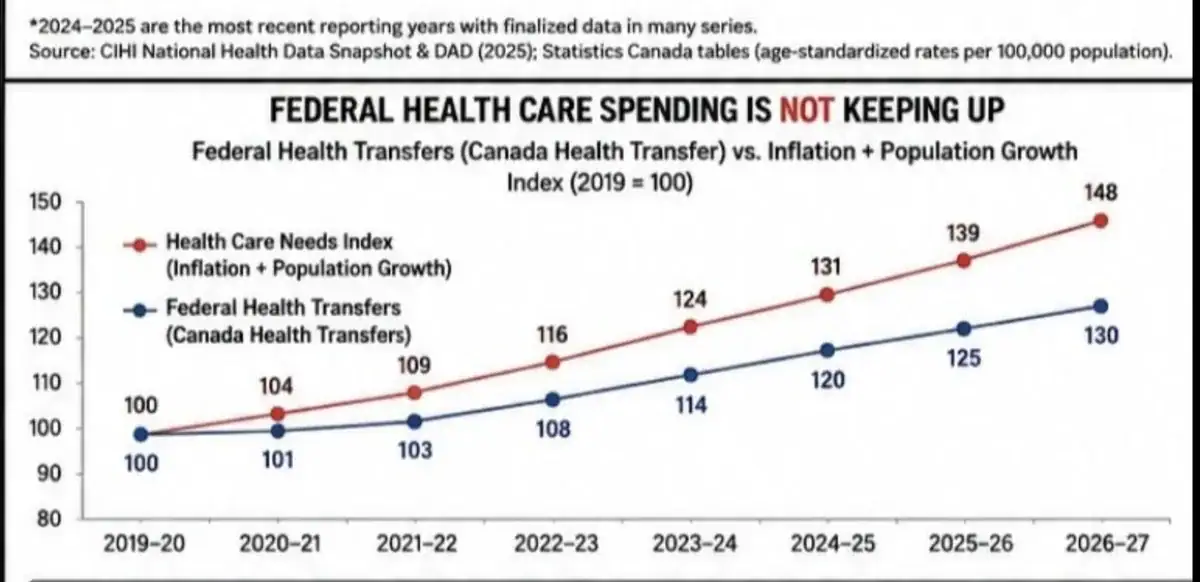
The accompanying chart illustrates the problem. Using 2019 as its baseline, the Health Care Needs Index, reflecting inflation and population growth, is projected to reach 148 by 2026 to 2027. Over the same period, the Canada Health Transfer index reaches only 130. The resulting 18 point gap represents mounting pressure on provincial health systems, hospital operators and the communities they serve.

Federal transfers are only one part of Canada’s health-care funding system, but the trend is instructive: public funding alone cannot always provide every facility, program and piece of equipment communities need, when they need it.

This does not mean philanthropy should replace government responsibility for essential health care. It means that philanthropy and carefully structured corporate sponsorship must increasingly be considered legitimate and necessary components of health-care development.

Southern Alberta Has Shown What Is Possible

The recently successful campaign for the Cardiac Centre of Excellence in southern Alberta provides a compelling example.

The campaign reached, and exceeded, its $30 million community target approximately six months before its planned conclusion. It did so in just 24 months, anchored in a smaller city serving a large rural and regional population.

Its success was not accidental.

The project grew out of years of physician advocacy around a critical, identified gap in cardiac care in southern Alberta, supported by an external Cardiac Sciences Advisory Cabinet before the Foundation was formally approached. Residents of southern Alberta faced an unacceptable gap in access to advanced cardiac diagnosis and treatment. Patients and families understood the consequences of travelling long distances for time-sensitive care. Employers recognized the importance of stronger regional health services to workforce recruitment, retention and community stability.

But urgency alone does not raise $30 million.

The campaign succeeded because of a carefully structured governance and execution model. After the Board approved a campaign feasibility study, an independent consultant engaged Global Philanthropic Canada to conduct it. Following Board approval of the $30 million campaign goal, the Foundation contracted an independent campaign manager who subcontracted Global. A dedicated team, comprising physician leadership, the Cardiac Sciences Advisory Cabinet, the Foundation Board, a volunteer Prospect Working Group, fund development professionals, and marketing experts, worked in unison to prepare the market, engage prospective donors, and maintain the momentum needed to secure transformational commitments.

Award-winning marketing and communications support by WJ Agency translated a complex health-care project into a clear and emotionally resonant public case. Donors were not simply asked to fund equipment or construction. They were invited to help bring lifesaving cardiac care closer to home.

That distinction matters.

The Lesson for Other Communities

A major fundraising campaign to transform cardiac care in southern Alberta has surpassed its $30-million goal.

The Bringing Hearts Home campaign will create a cardiac centre of excellence at Lethbridge’s Chinook Regional Hospital, including a new catheterization lab, advanced CT and MRI scanners, and electrophysiology and echocardiography labs, with upgrades also planned for Medicine Hat Regional Hospital. The need is urgent: more than 1,300 southern Albertans travel to Calgary annually for cardiac care, in a region where the risk of dying from a cardiac issue is 26.9% higher than elsewhere in Alberta.

This campaign grew from years of physician advocacy and a community that believed deeply in the need for cardiac care closer to home. Our Foundation stepped forward because we believed in that vision. Reaching our $30 million goal six months early reflects the strength of the case and the commitment of our donors, physician and community leaders, Board, volunteers, staff and professional partners. Every part of this team helped turn a shared vision into something our community could move forward together.” said Crystal Elliott, Chinook Regional Hospital Foundation CEO.

The lesson is straightforward: if a smaller rural-serving city can raise over $30 million in 24 months, other communities can too.

But success requires more than a target and generosity. Before going to market, foundations must rigorously answer: Is the project urgent and compelling? Does the community understand why philanthropy is needed? Is the goal achievable? Are the right campaign leaders and prospects in place? Does the foundation have the capacity to execute? And can recognition be offered without compromising clinical integrity?

Southern Alberta proves ambitious results are possible when a compelling cause is matched with strong leadership and disciplined execution.
A Clear Next Step for Hospital Foundations

The question is no longer whether philanthropy has a role in sustaining and advancing health care. It clearly does. The real question is whether organizations are prepared to do it well, at the scale and speed now required..

Hospital foundations do not need to navigate this complexity alone, nor should they risk entering major campaigns without the right foundation in place. Global Philanthropic Canada provides the expertise, proven methodology and senior campaign leadership required to assess readiness, build confidence in the case, and deliver campaigns that achieve transformational results.

For hospital foundations facing growing pressure and rising expectations, the next step is clear: engage Global Philanthropic Canada early, before plans are finalized and before the campaign begins. That is how strong ideas become successful campaigns, and how communities turn funding gaps into funded solutions.

The funding gap is growing. The time to act is now.

For Canadian fundraisers, this is the argument we’ve been making for years. Fundraising isn’t transactional. It’s the mission’s lifeline. The donor relationship isn’t a sidebar. It is an organizational strategy. When a fundraiser secures a major gift, they’re building trust, aligning values, and creating a partnership that sustains impact. The CCO is getting a seat at the table. The Chief Development Officer should be right there beside them.

About the Author


Richard Walker, B.Sc. is a seasoned fundraising, business development, and project management professional with more than 30 years of experience across the environment, international, government, and community sectors in the Prairies and beyond.

Richard joined Global Philanthropic Canada in 2017 and has helped raise more than $450 million throughout his career. His expertise includes campaign management, major gift development, board development, sponsorship, pipeline management, and philanthropic naming.

A professional planner and frequent national and international speaker, Richard is also Vice-Chair of the Global Board of Directors and a member of the Canadian Institute of Planners’ Planning Student Trust Fund Board.

SHARE THIS ARTICLE

CATEGORIES

RECENT ARTICLES

ARCHIVES

Archives