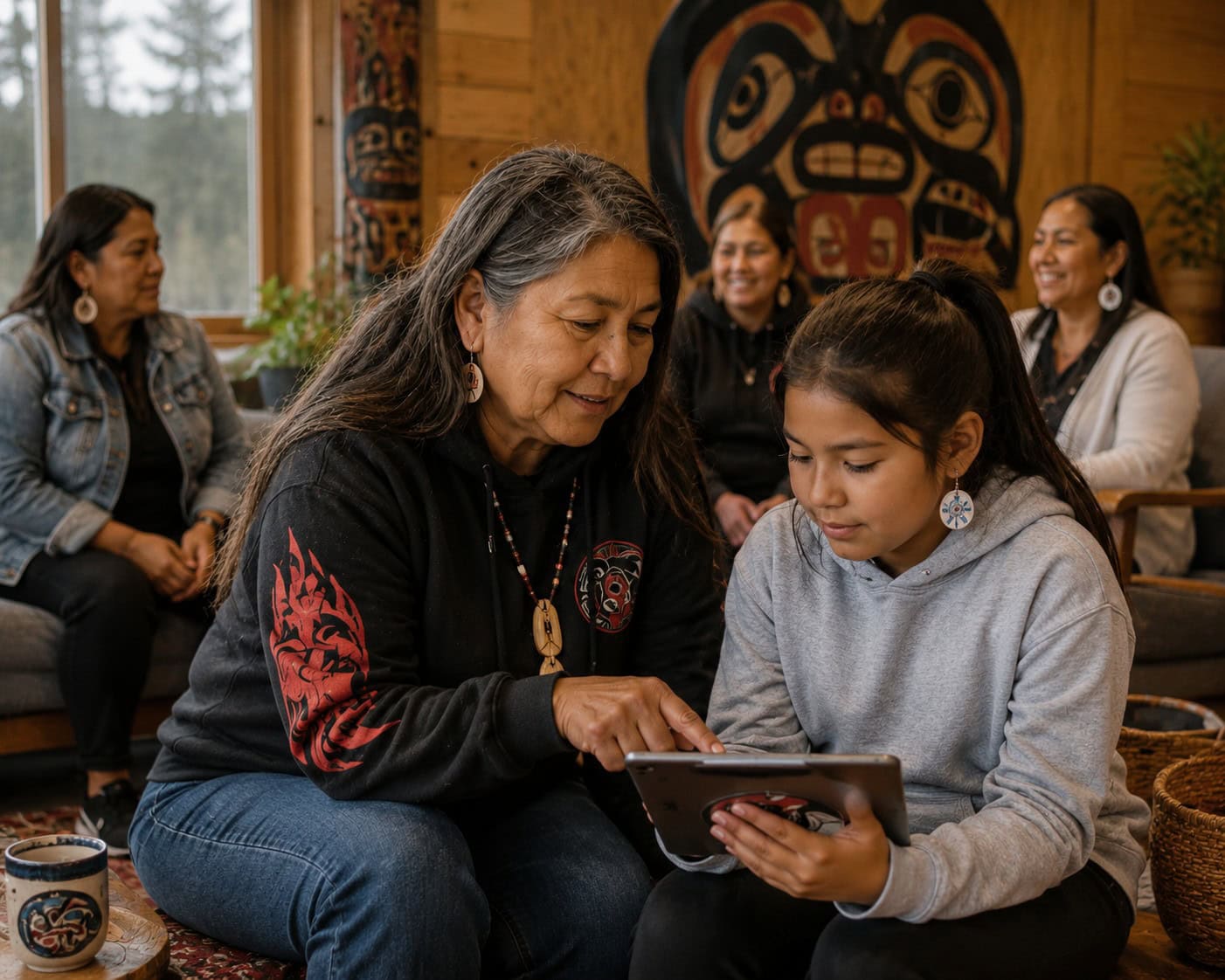
At the Nation2Nation Women’s Gathering in Prince George, a powerful and consistent truth emerged across voices, Nations, and leadership roles: the deepest lessons in leadership do not begin in boardrooms or institutions—they begin with maternal connection and the land itself. During a panel featuring Indigenous women leaders from various levels of government, the conversation was not about titles or hierarchy. It was about lineage, relationships, and the teachings that are carried forward across generations.
When these leaders spoke of “Mother,” they spoke expansively. Mother is not only a person—it is a role, a responsibility, and a source of knowledge. It includes biological mothers, chosen matriarchs, Grandmothers, Aunties, and other female voices of wisdom, as well as Mother Earth. Together, they form a living framework for leadership grounded in care, accountability, and a deep sense of responsibility to others.

For many Indigenous leaders, Mothers are the first teachers. They pass on language, culture, and values in ways that shape identity long before leadership is ever formally recognized. These teachings are often quiet, but they are enduring: listen before speaking, observe before acting, and understand your place within a larger whole. From this foundation, leadership is not something one claims—it is something one grows into, shaped by experience, guided by values, and rooted in relationship, and more often a sense of obligation.
The panelists shared stories not of formal authority, but of lived example—Mothers and Grandmothers who led through resilience, consistency, and an unwavering commitment to their families and communities. They modeled a kind of strength that is not about control or visibility, but about presence: showing up, holding others through challenge, and making decisions not for personal gain, but for collective well-being. These are not soft skills; they are essential.
What became equally clear is that these teachings do not remain as ideas—they move into action. They shape an approach to leadership grounded in doing what is right, even when it is difficult, and in stepping forward to serve in capacities that may sit outside traditional comfort or expectation. This action is not driven by ambition alone, but by respect—respect for those who taught us, for those we serve, and for the responsibilities we carry. It is this respect that gives leaders the courage to enter unfamiliar spaces, to advocate where their voices are needed, and to hold firm in their values when it would be easier not to.
Equally central to these teachings is the role of Mother Earth as a guide. In many Indigenous worldviews, the land is not a resource to be managed, but a relative to be respected. It teaches through its rhythms and patterns—through seasons that remind us of timing and renewal, rivers that demonstrate persistence and adaptability, and ecosystems that reflect the importance of balance and interconnection. Leadership shaped by these teachings carries a long view. It asks not only what is possible now, but what is sustainable for generations to come.
This creates a different kind of accountability. Leaders are not responsible only to stakeholders or systems, but to ancestors, to community, and to the land itself. Decisions are measured not just by outcomes, but by their impact on relationships and the future. It is a leadership approach that values reciprocity over transaction, and responsibility over recognition.
For Indigenous entrepreneurs and community leaders, this model offers a deeply grounded path forward. It centers values over visibility, collective success over individual achievement, and purpose over speed. It challenges conventional leadership norms that prioritize urgency and scale, and instead calls for thoughtfulness, balance, and intention.
One of the most compelling ideas shared at the gathering was a redefinition of strength. In many dominant leadership models, it is associated with decisiveness, authority, and control. In matriarchal traditions, it is equally defined by care, humility, and resilience. It is the capacity to carry community through uncertainty, to listen deeply when answers are not clear, and to remain grounded in identity, even in spaces where it is not always reflected.
This is not passive leadership—it is active, disciplined, and often requires immense courage. It asks leaders to hold complexity, to prioritize relationships, and to lead in a way that is both firm and compassionate. This is a form of leadership that may not always be the loudest in the room, but it is often the most enduring.
While these teachings are deeply rooted in Indigenous cultures, they are not unfamiliar to others. Across cultures, there is a shared understanding of the influence of mothers and maternal figures in shaping who we are and how we lead. What Indigenous perspectives offer is a fuller, more visible expression of that truth—one that extends maternal influence beyond the home and into entrepreneurship, governance, and community-building.
The conversations at Nation2Nation were a reminder that leadership does not have to be loud to be powerful. It can be steady, relational, and rooted in something far deeper than position or title. In a world increasingly focused on disruption and rapid change, matriarchal leadership calls us back to something essential: wisdom, connection, and responsibility.
My initial reason for attending the Nation2Nation gathering was rooted in business development—networking, relationship-building, and offering what I believed was a well-honed skill set that reflects Global Philanthropic Canada’s value-based content that I am proud to share. I left with a far deeper understanding of how I can truly serve. What stayed with me most was a reframing of leadership itself: beyond decisiveness and authority, it lives in care, humility, and resilience—the capacity to carry community through uncertainty, to listen deeply when answers are not clear, and to remain grounded in identity, even when it is not reflected around you.

Witnessing others honour their matriarchal influences created space for me to celebrate mine, and to recognize that while they may no longer be here, what they shaped in me continues to guide how I show up. It clarified that the values instilled in me are not separate from my professional path—they are central to it.
I move forward with a renewed commitment to integrate these teachings into my work: leading with intention, prioritizing relationships over transactions, listening before advising, and stepping into spaces with a grounded sense of purpose and respect—even when it calls me beyond familiar comfort.
Rooted in the teachings of those who came before, and rising with a strength that is both quiet and unshakeable, this is the kind of leadership that not only guides communities—but sustains them.
About the Author: Judy is the kind of leader who can chat corporate finance over coffee, pivot to impact investing by lunch, and still find time to jump into -32°C November waters for charity (yes, really—she took the “Chillin’ 4 Charity” plunge in Prince George, multiple times). Now a Senior Consultant with Global Philanthropic Canada’s Pacific team, she brings three decades of foundation leadership—including CEO roles at Spirit of the North, Prince George Community Foundation, and Central Okanagan Foundation—plus an ICD.D designation and a deep love for aligning purpose with impact. She advises boards and donors with wit, warmth, and an uncanny ability to turn complex challenges into measurable community change. And no, she still hasn’t fully defrosted.