
For Canadian non-profits seeking long-term financial sustainability in 2026, integrating Diversity, Equity, and Inclusion (DEI) into prospect research has transitioned from a theoretical aspiration to an operational imperative. As demographics rapidly shift across the country, traditional donor identification methods are leaving billions of dollars in philanthropic capacity unrecognized. This practical guide provides a comprehensive roadmap for advancement leaders, research teams, and philanthropic fundraising services to re-evaluate traditional wealth screening, eliminate algorithmic biases, and build highly effective, inclusive donor pipelines.
What is Equitable Prospect Research?
Equitable prospect research is the practice of identifying and evaluating potential major gift donors using inclusive, non-biased data frameworks that account for diverse wealth generation and philanthropic customs. Unlike traditional screening models that rely heavily on single-family real estate and public stock filings, equitable research evaluates holistic asset ownership, community leadership, and self-identified affinity.
By intentionally adjusting traditional algorithms and metrics, development teams can uncover high-net-worth (HNW) individuals from racialized, Indigenous, newcomer, and underrepresented communities who are frequently overlooked by automated wealth-screening engines.
Why is DEI Critical for Donor Pipeline Development in 2026?
Canada’s rapidly shifting demographics demand a modernized approach to donor identification. Newcomers currently account for nearly 20% of the population, and projections indicate that by 2036, up to 1 in 3 Canadian residents will be foreign-born, according to data highlighted by The ENGAGE Blog by Blackbaud.
Despite common misconceptions that newcomers are primarily beneficiaries of charitable services rather than contributors, research demonstrates profound giving potential:
-
$1.7 Billion in Untapped Potential: Imagine Canada’s Multicultural and Newcomer Charitable Giving Study revealed an estimated $1.7 billion in untapped annual giving across major multicultural populations in Canada.
-
High Giving Rates: 74% of multicultural Canadian respondents donate to charitable causes, making an average annual gift of $857.
-
The Solicitation Gap: 39% of respondents stated they would support more charities if asked more frequently, and 9% cited not giving simply because no organization had ever solicited them.
While the sector recognizes this opportunity, operational execution remains uneven. The 2025 Carleton University CICP report found that while 80% of Canadian non-profits report pursuing equity initiatives, Imagine Canada’s Equity Benchmarking Project indicates that these principles are rarely applied intentionally to core revenue-generating functions like major gifts.
How Do Traditional Wealth Screening Tools Create Bias?
Standard wealth indicators introduce structural biases at every stage of the prospect evaluation cycle by measuring the classic triad—Capacity, Inclination, and Affinity—through an inherently narrow lens.
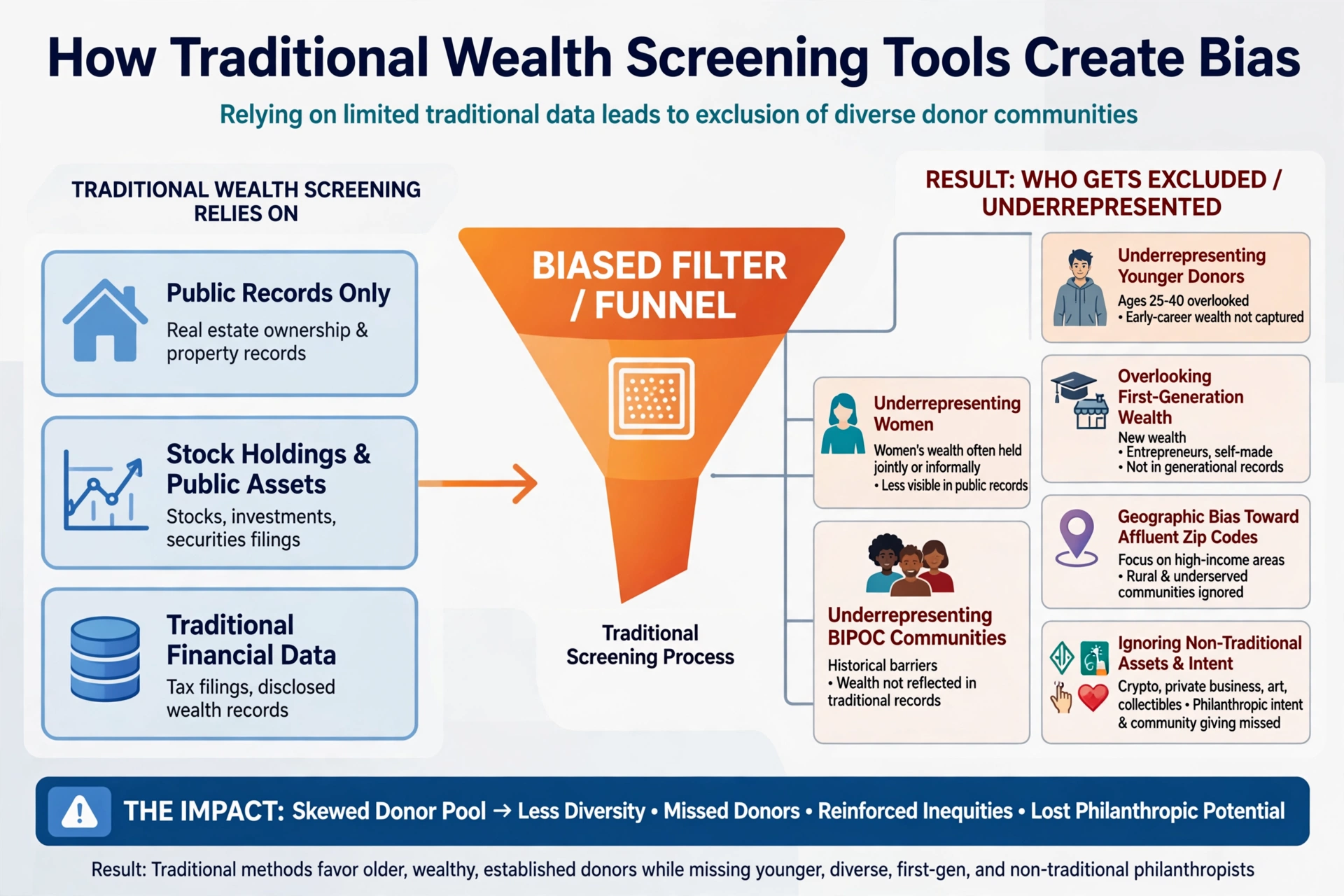
Traditional screening methodologies penalize diverse wealth in four distinct ways:
-
Real Estate Valuations: Traditional vendor algorithms heavily weight single-family residential property ownership. This effectively penalizes HNW individuals who invest in commercial holdings, multi-generational family properties, or international assets.
-
Public Corporate Filings: Automated wealth aggregators primarily scan public filings for corporate executives. Consequently, HNW entrepreneurs of color and newcomer business leaders who build wealth through privately held enterprises or professional corporations are systematically omitted.
-
Legacy Giving Records: Relying on historical donor registries reinforces systemic privilege. Scanning past donor lists for major gift prospects simply recycles the same demographic profile if the institution historically engaged a narrow audience.
-
Algorithmic and AI Bias: As noted in Hilborn Charity eNews, predictive AI models trained on historical fundraising data inherit and amplify historical biases, creating a self-fulfilling loop that ranks diverse prospects lower due to a lack of past solicitation data.
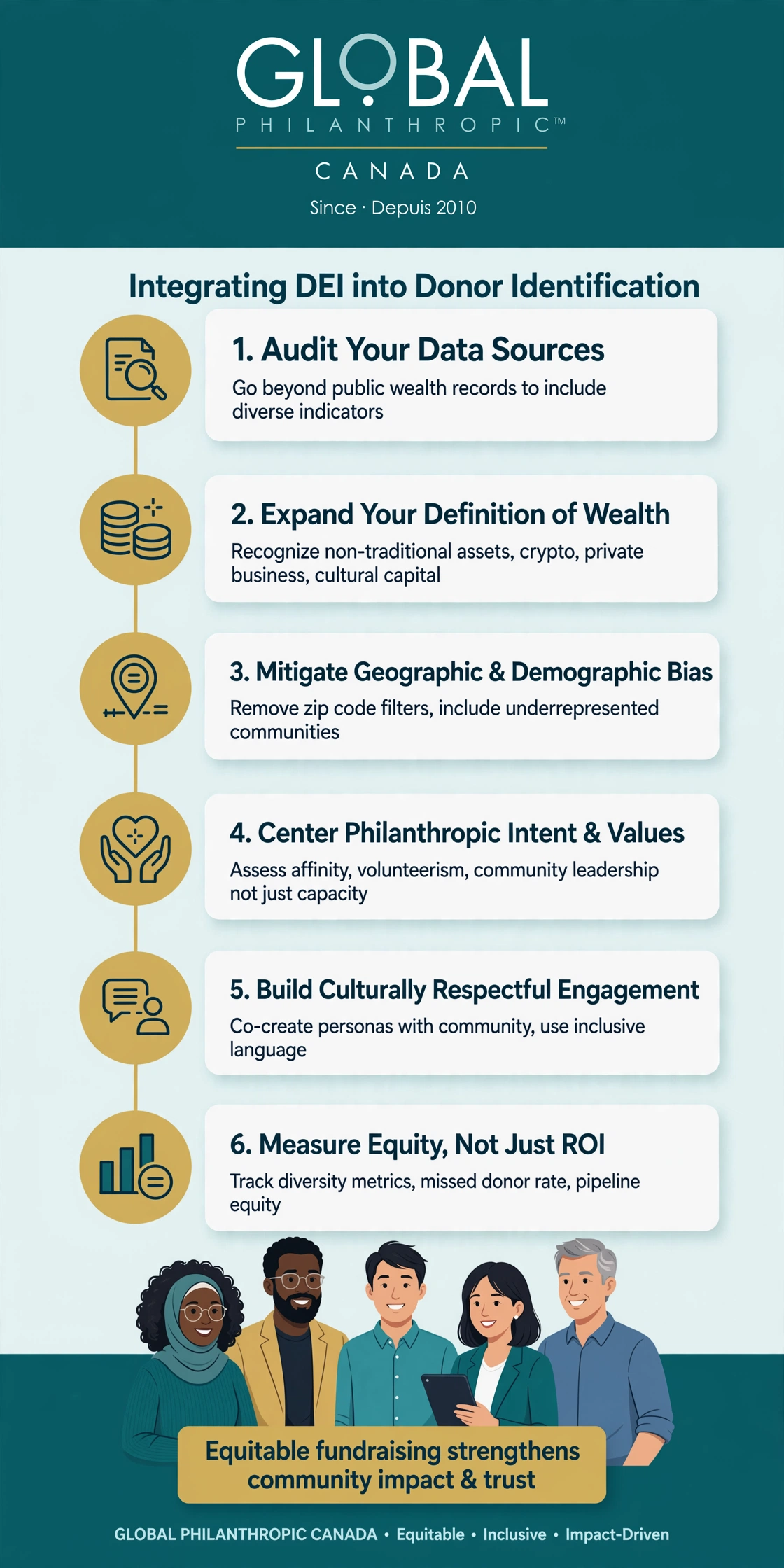
Step-by-Step Guide to Integrating DEI into Donor Identification
To build an equitable prospect pipeline, development offices must implement concrete operational shifts across their data management and research processes.
Step 1: Establish Ethical Frameworks and Data Stewardship
Organizations must balance constituent privacy with ethical data collection to avoid harmful profiling. As outlined by the Apra Statement of Ethics and the Apra DEI Data Guide, tracking diversity requires strict guidelines.
-
Never Infer Identity: Prospect researchers must never attempt to infer race or ethnicity by examining photographs or guessing based on surnames, a practice Jennifer Filla explicitly flags as unethical.
-
Prioritize Self-Identification: Identity data should only enter a CRM through explicit self-identification, such as opt-in surveys or alumni affinity group registrations.
-
Formalize a Data Policy: As detailed by Apra Connections, teams should document the precise purpose, governance, and transparency measures for collecting any diversity data.
Step 2: Re-Index Capacity Metrics
Forward-thinking institutions are shifting their research models away from absolute reliance on automated wealth screening tools. As documented in the Chronicle of Philanthropy and the Prospect Research Institute, successful teams manually re-weight alternative capacity indicators.
Instead of just looking at public stock, researchers should evaluate professional leadership trajectories, institutional affinity (such as task force participation), and community-based philanthropic engagement.
Step 3: Utilize Non-Bias Screening for Alternative Wealth
Prospect development teams must actively hunt for the “hidden figures” of philanthropy. Insights from Apra University recommend implementing non-bias screening techniques to evaluate alternative wealth assets.
Key strategies include utilizing business registries to identify owners of privately held firms, tracking donor-advised fund (DAF) distributions, and recognizing diverse cultural giving customs (like diaspora giving or faith-based tithing) that may not register on conventional non-profit honor rolls.
Step 4: Broaden Affinity and Community-Centric Prospecting
Wealth and proximity alone are insufficient indicators of a viable prospect. Insights from Campbell & Company stress that equitable prospecting requires a deep understanding of mission alignment and community networks.
Expand candidate pools by mapping leaders within diverse professional associations or chambers of commerce. Furthermore, partnering closely with frontline fundraisers helps identify emerging leaders within identity-based advisory groups, an approach championed by Apra Connections for jumpstarting a diverse donor pool.
How Global Philanthropic Elevates Inclusive Fundraising Strategy
Applying a rigorous equity lens to prospect research requires strategic leadership and deep sector expertise. As a trusted partner for Canadian non-profits, Global Philanthropic Canada is uniquely positioned to help organizations navigate this operational transition.
With 11 regional offices nationwide, Global Philanthropic delivers accessible, context-sensitive counsel to health foundations, higher education institutions, arts organizations, and Indigenous communities. Their senior consultants bring an average of 28 years of on-the-ground fundraising expertise and have successfully raised over $8 billion for more than 400 Canadian organizations since 2010.
Global Philanthropic integrates DEI into prospect strategy by conducting comprehensive pipeline audits to identify systemic screening biases. Through equitable campaign planning and executive board counsel, their holistic approach ensures that non-profits combine data-driven prospect research with culturally aware stewardship to maximize impact.
Securing the Future of Philanthropic Fundraising
We are a national network of professional fundraising experts. With offices from Halifax to Victoria, our Senior Consultants deliver professional, bold, and accessible fundraising counsel to organizations of all sizes in a respectful and inclusive environment. From annual giving, to strategic counsel, to prospect research and everything in between, we are here to help.
With $1.7 billion in multicultural giving potential currently left untapped, Canadian non-profits can no longer rely on legacy wealth screening metrics to fuel their major gift pipelines. By embracing ethical data stewardship, redefining capacity indicators, and partnering with experienced philanthropic fundraising services, organizations can build diverse, sustainable donor pipelines that reflect the true demographic landscape of modern Canada.